Computed results
What the data supports
Every number on this page is read from the analysis pipeline’s output files, not written by hand. Where the catalogue is too thin to support a claim, this page says so instead of rounding up.
Generated 2026-08-27 · 63 artists · 23 events · source and methods
Four results
Stated with the qualification each one needs, not the version that reads best.
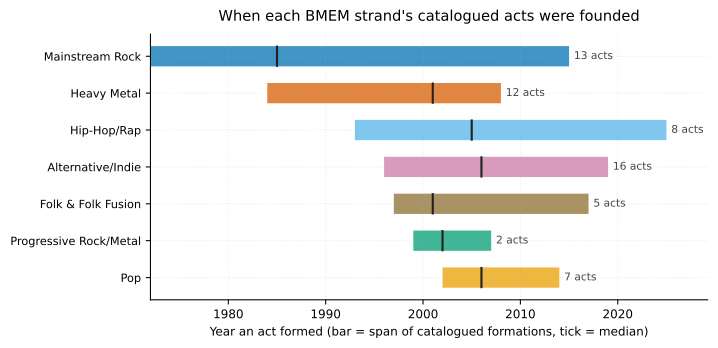
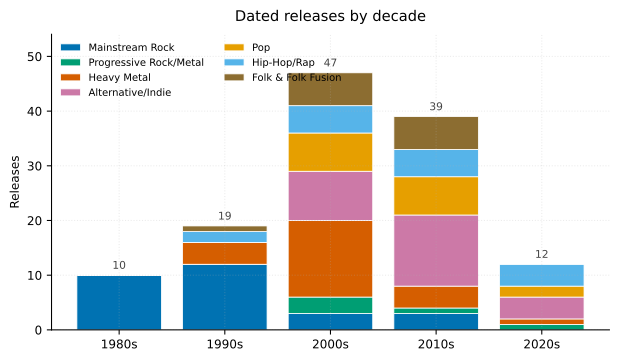
The catalogue's first hip-hop release (1993) predates its first alternative (1996), folk-fusion (1997), progressive (1999) and pop (2002) formations — two years after the first original Bangla metal album, not two decades.
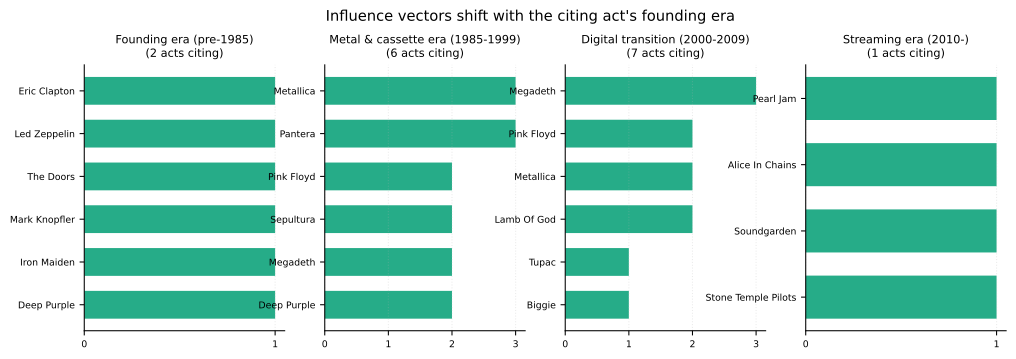
Metal and progressive acts name specific bands; pop and folk acts name traditions. That asymmetry reflects who gets interviewed as much as how music transmits, so it is reported as a property of the evidence.
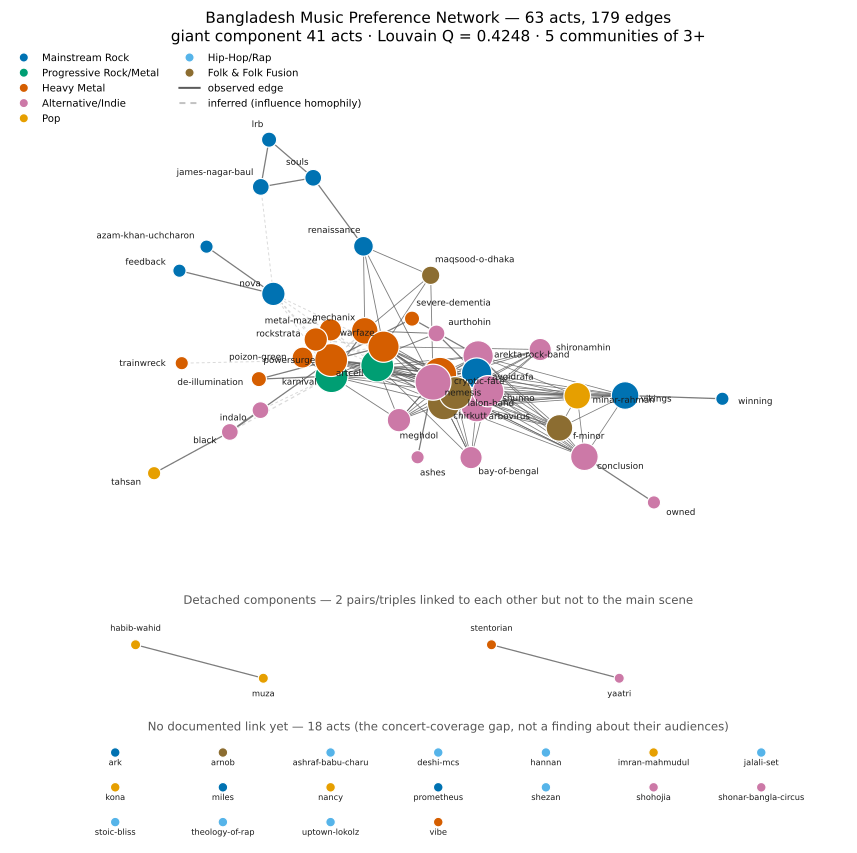
The communities are real, but the edges record shared bills, shared members and stated influences. The classic-rock community exists because Ayub Bachchu moved between those bands.
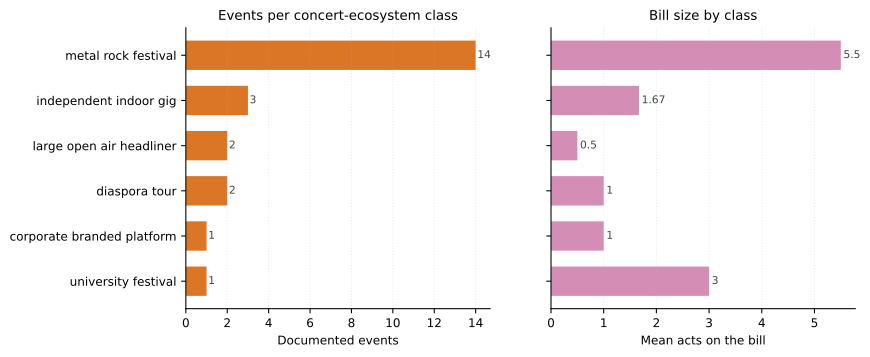
Every multi-act bill in the catalogue mixes genre strands. Large commemorative festivals turn out to be discovery spaces, not the subcultural gatherings the framework predicted.
Network structure
Three passes over the same 63 acts. 'Observed' uses only documented layers — shared bills, shared members, one act naming another. 'All layers' adds inferred influence-homophily edges at half weight. 'Co-billing only' reproduces the original single-layer prototype.
| Pass | Edges | Density | Largest component | Isolated | Modularity | Communities 3+ |
|---|---|---|---|---|---|---|
| Observed layers | 153 | 0.0783 | 36 | 20 | 0.4283 | 6 |
| All layers | 179 | 0.0917 | 41 | 18 | 0.4248 | 5 |
| Co-billing only | 133 | 0.0681 | 24 | 39 | 0.182 | 3 |
Communities in the observed graph
35 of 63 acts have no documented event, so low centrality here is usually a coverage fact rather than a finding. Removing the bill-size correction — which stops one twelve-act festival contributing 66 edges — drops observed modularity from 0.4283 to 0.154.
The concert ecosystem
28 of 63 catalogued artists have at least one documented event. Typology shares are therefore shares of the documented sample, which over-represents festivals and landmark shows because those are the events that get written about.
Multi-band rock/metal festival; high-commitment subcultural audience, repeat attendance.
Smaller indoor show; dedicated attentive audience, alternative/artistic identity.
Overseas show for the Bangladeshi diaspora; audience is expatriate and multi-generational.
Open-air or stadium-scale headline show; broad multi-generational audience, communal/nostalgic.
Campus-organised event; student audience, eclectic bill, functions as a discovery space.
Brand-funded studio or showcase format; high production values, cross-genre pairing by design.
A defined class with no entries, across eight catalogued hip-hop acts. This is a sourcing failure, not a fact about Bangladeshi hip-hop: the project’s event sources are outlets that cover rock festivals.
Global influence and local adaptation
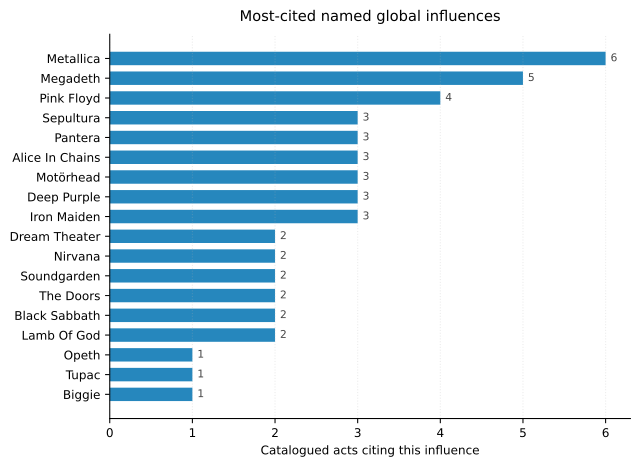
Free-text influence citations were split on '/' and ',', stripped of parentheticals, and classified as a named global act, a generic tradition label, or a domestic (catalogued) act. Each canonical token's kind is resolved once over the whole corpus (see common.resolve_token_kinds), so an influence cannot count as a named act in one cross-tab and a tradition in another. Ranks count DISTINCT CITING ACTS, not citation rows, so an influence's rank reflects how many acts in this sample name it -- not its measured effect on the music.
Most-cited global influences
- Metallica6
- Megadeth5
- Pink Floyd4
- Sepultura3
- Pantera3
- Alice In Chains3
- Motörhead3
- Deep Purple3
- Iron Maiden3
- Dream Theater2
- Nirvana2
- Soundgarden2
Counted by number of citing acts. Only 10 influences are cited across more than one strand.
Documented adaptation mechanisms
- bangla language choice36
- folk or baul motif20
- political or social20
- literary or poetic8
- religious or spiritual4
- urban vernacular4
Counts of acts whose records document each mechanism. These measure how the records were written, not what the music does — the hip-hop strand’s single political-content marker contradicts the academic literature and is treated as a documentation artefact.
Formation over time
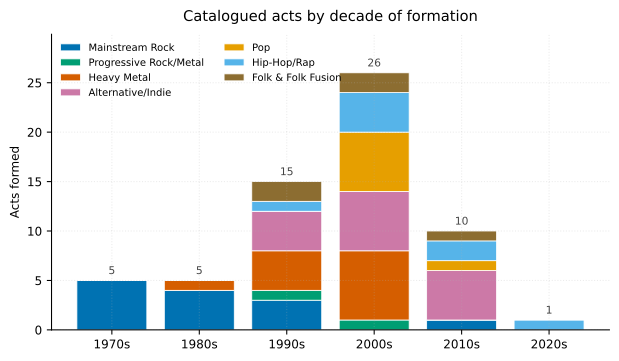
All counts describe the catalogued sample (63 artists, 23 events), not the national population of Bangladeshi acts or events. Decade figures therefore show the shape of the documented record, and recent decades are better covered than early ones.
127 dated releases, median gap between an act’s releases 5 years. The 2020s column is low because recent acts have not yet accumulated the documentation this catalogue is built from — not because band formation stopped.
Figures
Rendered directly from the computed outputs, so no figure can disagree with a number reported above.
What this project cannot do
These bound every number above.
- No audience data of any kind
No streaming, playlist or engagement signals — blocked pending Spotify and YouTube API credentials. Every listener claim here is inferred from co-billing and from what artists and journalists said.
- No audio-feature analysis
Every statement about tempo, production or arrangement rests on documented description and discographic sequence, not on measured signal.
- Measurable documentation bias
The hip-hop strand shows one political-content marker against six for alternative rock, contradicting the literature. Reported as an artefact rather than a finding.
- Geographic concentration
19 of 23 events are in Dhaka. The ecosystem outside the capital is nearly invisible here.
Full method, limitations and the framework revisions these results forced: the research paper and the BMEM validation.